Back to Ephemerides overview
· Ephemerides

Observation date

Jupiter

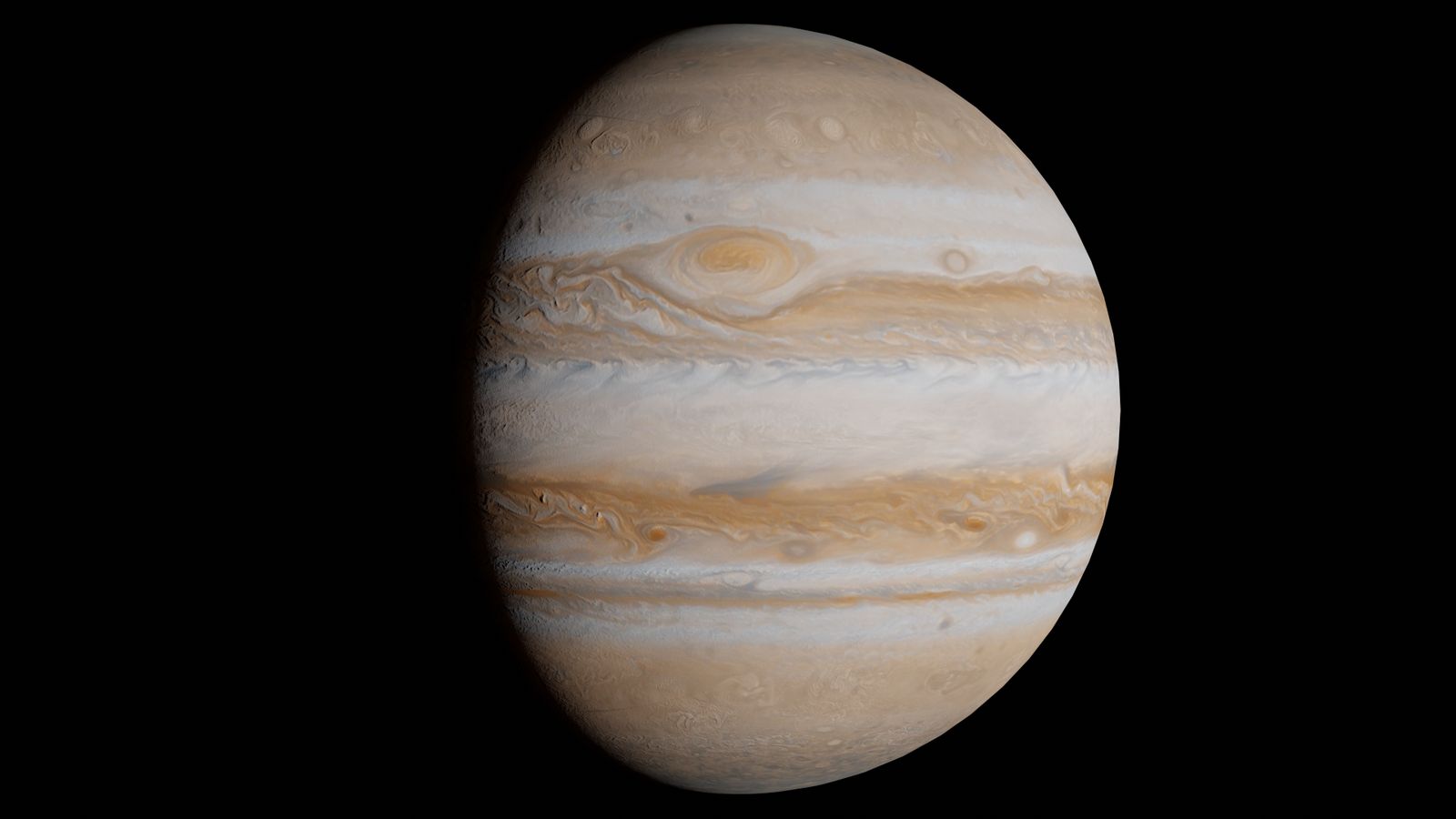
The largest planet in the Solar System, a gas giant with a powerful magnetic field and an extensive moon system.
AU
5.281
ECL
125.3°
MAG
-1.79
Jupiter

01 — Current astronomical data

Parameters and context

Heliocentric distance
5.281 AU
Ecliptic longitude
125.26°
Ecliptic latitude
0.54°
Apparent magnitude
-1.79 mag
Right ascension
8 h 23 min
Declination
19.88°
Altitude above horizon
-13.3°
Azimuth
29.1°

Astronomical overview

Jupiter’s atmosphere is dominated by hydrogen and helium. The Great Red Spot is a long-lived anticyclonic storm larger than Earth.

Astrological meaning

In astrology, Jupiter is associated with expansion, growth, education and long-term perspective.

Mythology

The name comes from Jupiter, the chief god in Roman mythology.

02 — 05

Key facts

  1. 01Its strong magnetic field creates extensive radiation belts.
  2. 02Its atmosphere shows well-defined cloud bands and zones.
  3. 03The four largest moons are Io, Europa, Ganymede and Callisto.
  4. 04Ganymede is the largest moon in the Solar System.
  5. 05Jupiter has a faint ring system made mostly of dust.

Parameters and context

Sidereal day
9 h 56 min
Solar day
9 h 56 min
Year length
4,333 days (~11.86 Earth years)
Rotation speed
45,000.0 km/h • 36.24°/h
Orbital speed
13.10 km/s
Distance from Sun
778.60 million km
Diameter
139,820 km
Gravity
24.8 m/s²
Mean temperature
-110 °C