Back to Ephemerides overview
· Ephemerides

Observation date

Neptune

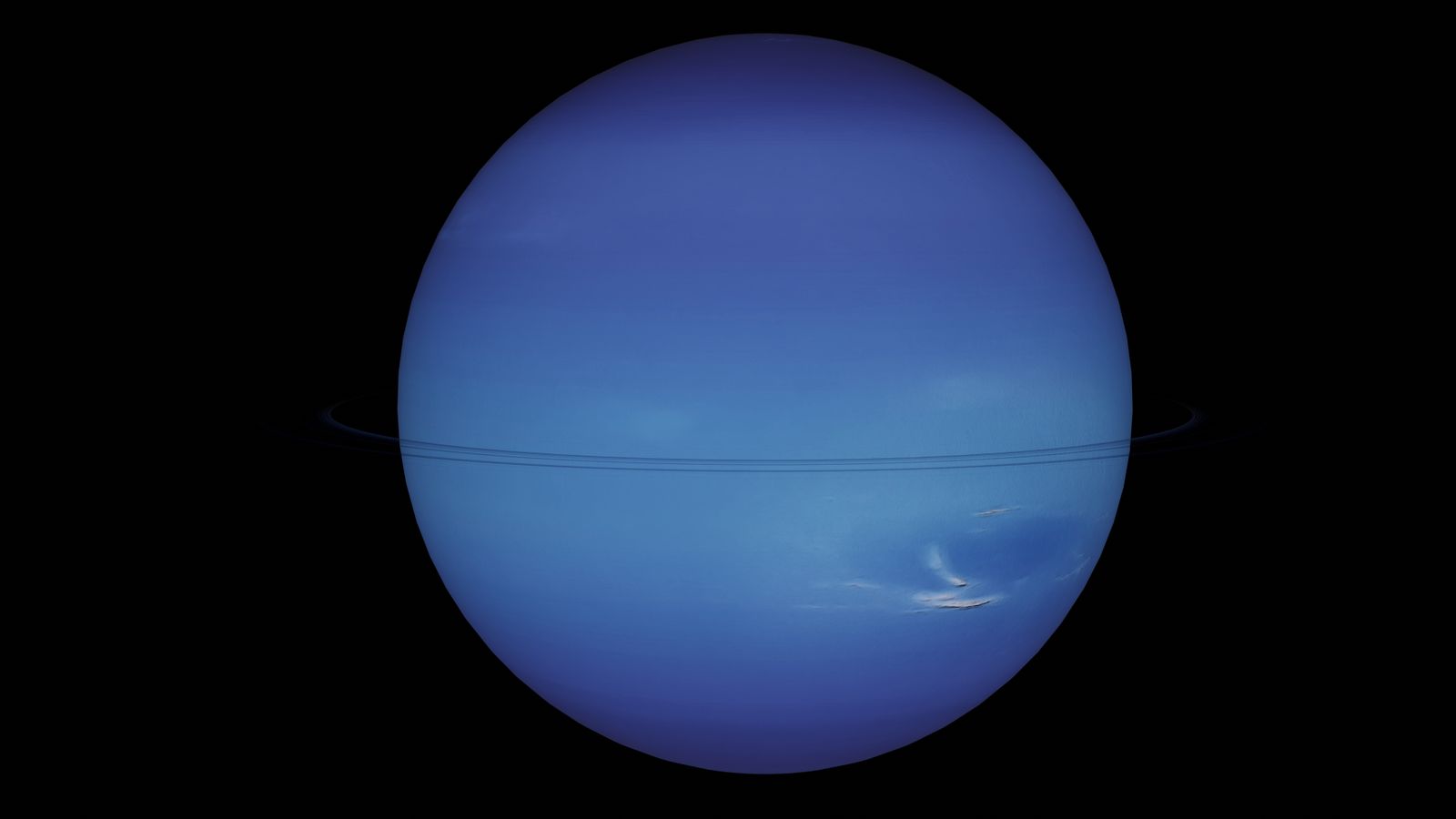
The outermost major planet, an ice giant with highly dynamic weather and the fastest winds in the Solar System.
AU
29.880
ECL
2.6°
MAG
7.86
Neptune

Astronomical data

Parameters and context

Heliocentric distance
29.880 AU
Ecliptic longitude
2.56°
Ecliptic latitude
-1.36°
Apparent magnitude
7.86 mag
Right ascension
0 h 18 min
Declination
0.48°
Altitude above horizon
-11.0°
Azimuth
285.3°

Astronomical overview

Neptune has a deep blue appearance and active meteorology, including dark storm systems analogous to large anticyclones.

Astrological meaning

In astrology, Neptune is associated with imagination, intuition, sensitivity and symbolic perception.

Mythology

The name comes from Neptune, the Roman god of the sea (Greek Poseidon).

Key facts

  • It was mathematically predicted before direct telescopic discovery.
  • Wind speeds can exceed 2,000 km/h.
  • Triton orbits retrograde relative to Neptune’s rotation.
  • Neptune has faint, dark dust rings.
  • Its brightness varies over long time scales.

Parameters and context

Sidereal day
16 h 6 min
Solar day
16 h 6 min
Year length
60,190 days (~164.79 Earth years)
Rotation speed
9,660.0 km/h • 22.36°/h
Orbital speed
5.40 km/s
Distance from Sun
4,495.10 million km
Diameter
49,244 km
Gravity
11.2 m/s²
Mean temperature
-201 °C