Back to Ephemerides overview
· Ephemerides

Observation date

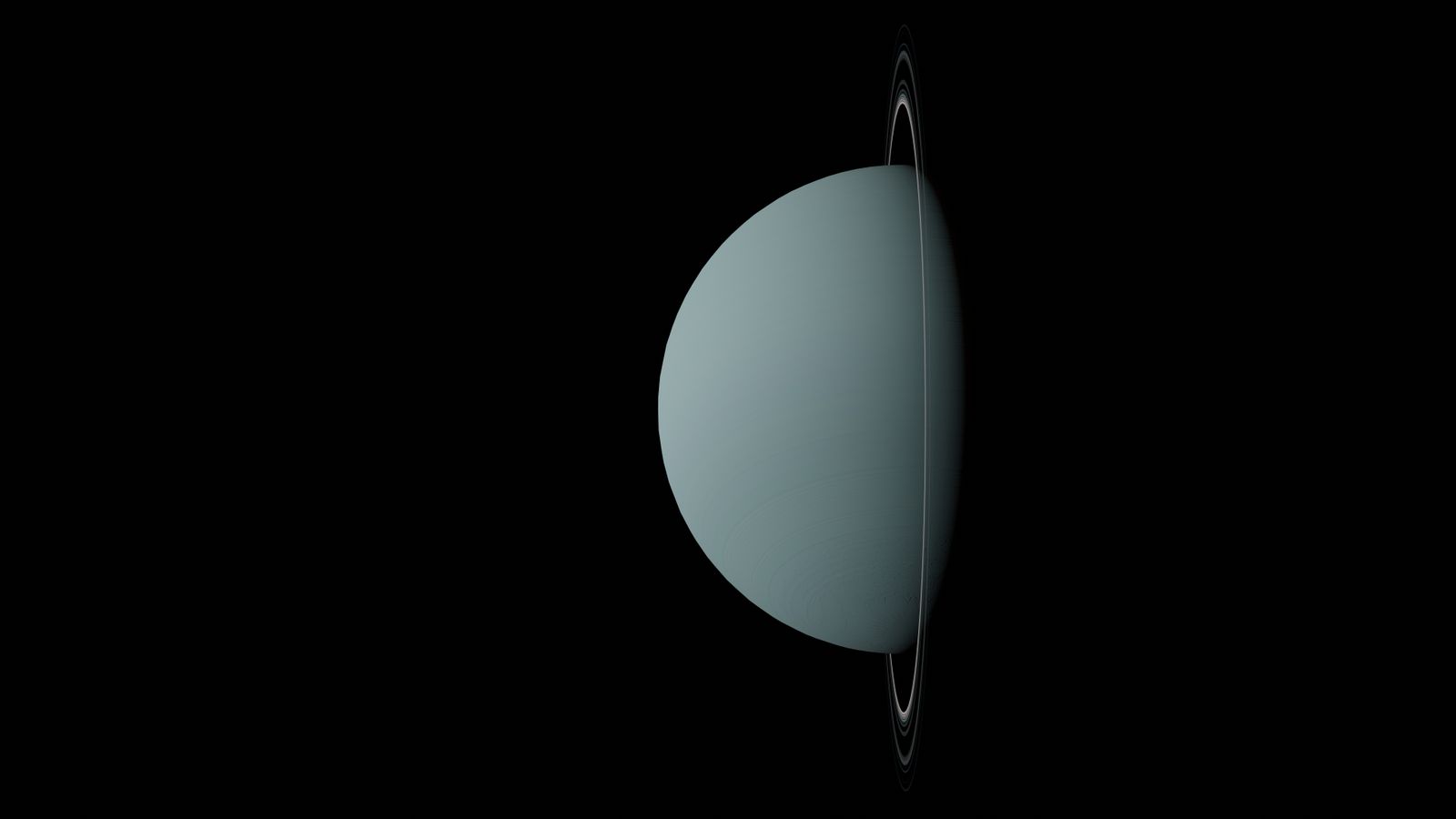
Uranus

An ice giant with an axial tilt of about 98°, effectively rotating on its side.
AU
19.455
ECL
62.1°
MAG
5.78
Uranus

01 — Current astronomical data

Parameters and context

Heliocentric distance
19.455 AU
Ecliptic longitude
62.14°
Ecliptic latitude
-0.16°
Apparent magnitude
5.78 mag
Right ascension
4 h 10 min
Declination
20.86°
Altitude above horizon
18.4°
Azimuth
79.4°

Astronomical overview

Uranus appears blue-green because methane absorbs red wavelengths in its upper atmosphere.

Its extreme axial tilt creates unusual seasonal geometry.

Astrological meaning

In astrology, Uranus is linked to breakthroughs, innovation and disruption of old patterns.

Mythology

Uranus is the only major planet named directly after a Greek deity, Ouranos, the personification of the sky.

02 — 05

Key facts

  1. 01It was discovered telescopically by William Herschel in 1781.
  2. 02It has rings, though fainter than Saturn’s.
  3. 03It has 27 known moons, many named after Shakespearean characters.
  4. 04Its magnetic field is significantly offset from the planet center.
  5. 05Its orbital period is about 30,687 Earth days (~84.0 Earth years).

Parameters and context

Sidereal day
17 h 14 min (retrograde)
Solar day
17 h 14 min
Year length
30,687 days (~84.02 Earth years)
Rotation speed
9,320.0 km/h • -20.89°/h
Orbital speed
6.80 km/s
Distance from Sun
2,872.50 million km
Diameter
50,724 km
Gravity
8.7 m/s²
Mean temperature
-195 °C